What if ADHD shame is just failed regulation wearing an identity mask?
In the aftermath of a financial crisis or a significant personal lapse, we often look at the mountain of debt or the broken trust and assume the problem began with the first missed payment. It is a clean, logical starting point.
But for many—particularly those navigating the complexities of ADHD—the real work of the crisis was finished long before the numbers became undeniable.
By the time a situation becomes “real,” a narrative has already been written. It is a story not of facts, but of identity.
The Replacement of Reflection
We are taught that shame is a moral aftertaste: you cross a line, you reflect, and shame arrives to signal a transgression. In practice, however, shame rarely follows reflection; it replaces it.
When faced with a flicker of discomfort—a bill we forgot to pay or a task we avoided—the brain seeks an immediate resolution to that tension. Instead of a slow consideration of context, a conclusion lands: “I’m a person who betrays trust.” “I am a failure.”
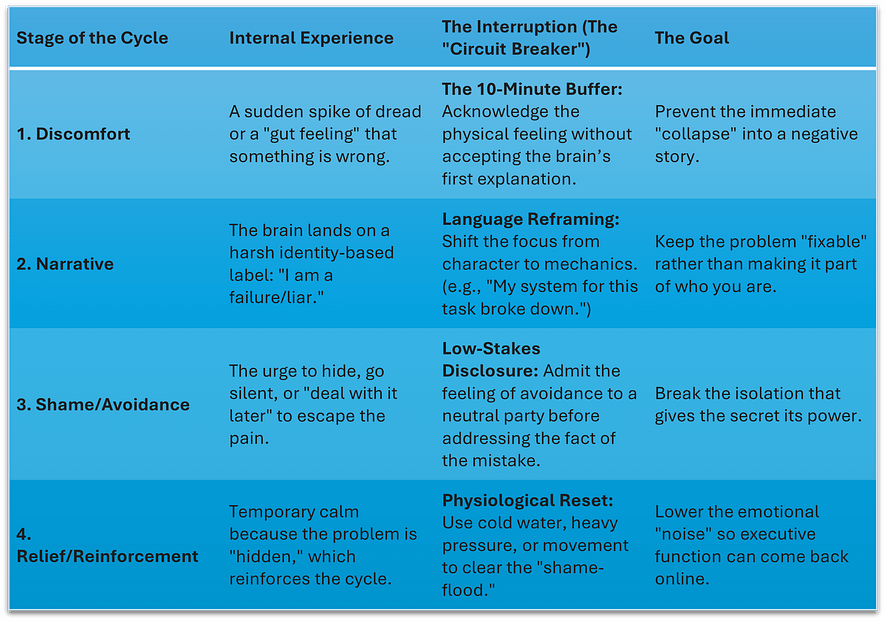
Once this narrative is established, a predictable cycle of self-regulation begins:
- Discomfort: An initial trigger or mistake occurs.
- Narrative: The brain creates a harsh, definitive story about what this means (Identity).
- Shame: The emotional weight of that story floods the system.
- Avoidance: To escape the pain of the shame, we hide or ignore the problem.
- Relief: Temporary safety is found in silence.
- Reinforcement: The brain learns that avoidance “works,” making the loop faster next time.
The ADHD Velocity
This cycle is not unique to ADHD, but the neurobiology of ADHD changes its velocity.
There is often less “white space” between a feeling of discomfort and the interpretation of that feeling. Without the executive function to sit in uncertainty or hold multiple possibilities at once, the brain reaches for the closest, most efficient explanation.
Unfortunately, the harshest explanation - “This is who I am” - is also the most efficient. It requires no nuance or context. Once the situation is internalized as an identity flaw, possibilities collapse.
“This is manageable” becomes “This is catastrophic.”
"For the ADHD brain, rejection isn't a possibility to be managed; it’s a physical pain to be avoided at all costs. Often, we choose the slow burn of a secret over the sharp sting of a conversation, because we’ve already convinced ourselves the verdict is 'guilty' before the trial has even begun."
The Paradox of Functional Shame
Perhaps the most difficult realization is that this system is doing exactly what it was designed to do. It is regulating the self, albeit unsustainably.
For many, shame becomes a tool—a primitive way to stay aware of a problem or maintain a sense of control. There is a deep-seated fear that if the shame is removed, everything will crumble. If you aren’t beating yourself up, will you care at all?
This transforms shame from a simple emotion into a survival mechanism. It feels risky to let go of the very thing that has been keeping the secret “contained.”
Shifting the Leverage Point
If shame is the “cover story” for a system that couldn’t manage a moment of dysregulation, then attacking the shame directly often misses the mark. You can know the outcome won’t be as bad as you imagine, and yet remain paralyzed. Knowledge is not the same as activation.
Under the weight of a shame-narrative, the system that converts urgency into action goes offline.
To break the loop, the focus must shift from the end of the cycle to the beginning. We must look at the moment before the story took hold.
Instead of asking, “Why do I feel so much shame?” the more productive question is:
“What was I trying to manage just before this became a story about who I am?”
When we view these lapses not as moral failures but as moments of rapid, internal sense-making, the problem changes.
It is no longer a question of character, but of mechanics. And once we understand the mechanics of the narrative, we can finally begin to rewrite the ending.
“Shame is the story we tell ourselves to explain the pain of perceived rejection before anyone else has the chance to say a word.”
Breaking the Shame Loop: A Strategic Guide